Sunday, 26 October 2014

The Working Memory Model

Apologies for the late post.

On Wednesday we studied the Working Memory Model. This is a model of short-term memory only. We discussed the Central Executive, the Phonological Loop and the Visuo-Spatial sketchpad, and looked at research evidence that supports the different components.


Wednesday's powerpoint is here.

Your homework over half-term is to complete the mini-projects that we started in class today. The title is 'Does articulatory suppression eliminate the word-length effect?'. Write-ups are to be done individually, and must follow a standard layout - the sheet that explains how to do this is here.

We will also have a short progress test in our next lesson (Wed 12th Nov) on the MSM and WMM.


Wednesday, 8 October 2014

The multi-store model of memory


Today we put all our previous knowledge about capacity, duration and encoding together in the multi-store model of memory. We discussed sensory memory, and then the advantages (easy to study/intuitive/commonsense/accounts for some research findings) and disadvantages (reductionist/doesn't account for different types of info) of the model. Supporting evidence for the MSM comes from Glanzer & Cunitz (the serial position curve), brain imaging research and evidence from brain-injured patients, eg HM and Clive Wearing.

Today's powerpoint is here.

I also set an essay, this is due in on WEDNESDAY 22ND OCTOBER.

The title is 'Give a brief account of the differences between STM and LTM, and consider the extent to which research supports the distinction between them' (12 marks). A suggested essay plan is here

Wednesday, 24 September 2014

Capacity, duration and encoding


Today we covered what felt like a huge amount of content; well done for a busy lesson. I'll list all the resources below:


I gave out research methods booklets, here is an electronic version, please bring these every lesson. The plan is to start every lesson with 15 minutes RM.

I also handed out a schedule for the whole term. Here is a copy.


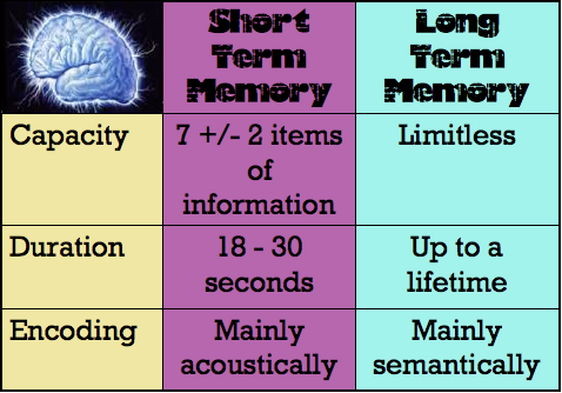
We covered duration in LTM; we discussed children's TV programmes and the difference between recall and recognition. We looked at Bahrick's study, which found good evidence for the duration of long-term memories. Recognition (cue provided) was better than recall. Here is the duration in LTM powerpoint.

We then looked at capacity in STM. We measure our average digit span to be around 7.2 items. Miller defined STM capacity as being 7 plus or minus 2, and looked at the idea of chunking. We discussed postcodes and telephone numbers as real life applications of chunking. Remember that chunking isn't wholly foolproof; the size of the chunk does matter (Simon, 1974). Here is the capacity powerpoint.

Finally we discussed encoding in STM and LTM. We replicated the Baddeley (1966) study. For STM, participants did worse in the acoustic similarity category. Baddeley concluded that this meant that the brain codes acoustically in STM. This is a crucial point! If you don't follow, please ask next lesson. For LTM, people performed worse in the semantic similarity category, showing that this is how the brain codes in long-term memory. Here is the encoding powerpoint.


It's vital that you go over the powerpoints and all the information covered today. This will be easier when you have textbooks but is still possible now. 

Wednesday, 10 September 2014

The man who keeps falling in love with his wife


Today we introduced our first unit 1 module - memory. We discussed the case of  Clive Wearing and the implications of this for how important memory is. Here is an interesting summary of Clive's memory history. Interestingly, his musical memory appears intact and this article explores why this might be.

Here is today's powerpoint containing the notes on Peterson & Peterson (1965).

Mrs Watson