Wednesday, 22 April 2015

Day care

Today was our final lesson on attachment, and we covered the pros and cons of day care, and also implications for childcare practice of attachment research. We looked at some studies giving different outcomes for childrens' aggressive behaviour and their relationship with peers. The studies often seem to contradict each other, and we looked into some of the reasons for this (essentially the studies are not all comparing like with like).

Today's ppt is here. I also handed out revision booklets. It is your job to make sure that you can write an essay for each of the titles listed in the booklet, for each topic. Any essay that comes up on your paper will only be a variation of one of these. 

Wednesday, 25 March 2015

Institutionalisation


Today we looked at the effects of institutionalisation - when children are brought up in an institution like a children's home or orphanage. This often includes privation - when the child has never formed an attachment. We looked at Rutter et al, which is a big longitudinal study looking at the long term effects on children adopted into the UK from Romanian orphanages.

Today's ppt is here. The sheet on whether or not recovery from privation is possible is here.

The homework essay for today is: 'Outline and evaluate research into the effects of institutionalisation (12 marks). This is due next lesson, 22nd April.

Wednesday, 11 March 2015

Disruption of attachment and privation


Today we looked at what happens when children either form an attachment which is temporarily disrupted, or never form an attachment (privation). We discussed the case studies of the Robertson children, and then looked at Genie and the Koluchova twins. Finally, we looked at the Hodges & Tizard study into recovery from early privation. Today's ppt is here

Wednesday, 25 February 2015

Cultural variations in attachment


Today we looked at one study in lots of detail - the meta-analysis by Van Ijzdendoorn into cross-cultural differences in attachment. You need to know the main findings (don't forget that the main findings is that secure attachment was the most common in all cultures), and then looked at criticisms of the study.

Today's ppt is here.

The next essay is due in on 11th March. The title is 'Discuss research into cultural variations in
attachment' (12).

Wednesday, 4 February 2015

Individual differences in attachment


Today we looked at Ainsworth's Strange Situation - a controlled observation that aims to measure individual differences in attachment. We looked at how she defined secure, insecure avoidant and insecure resistant attachment types - and you need to be able to recite these.

Ainsworth concluded that the mother's behaviour was the cause of the attachment differences - this is the sensitivity hypothesis and is firmly on the nurture end of the nature-nurture spectrum. The alternative is the temperament hypothesis, which states that the innate differences in infant temperament are what cause the differences. We looked at research that supports both ideas.

Today's ppt is here.

The next essay is due on Feb 25th and is on the second slide of the ppt.

Wednesday, 21 January 2015

Bowlby's theory of attachment


Today we looked at Bowlby's evolutionary theory of attachment. He said that attachment is adaptive (necessary for survival) and that it is necessary to form a template for how future relationships work.

Today's powerpoint is here.

The powerpoint showing the model answers for the AS mock is here.

Here is the summary activity on Bowlby that I asked you to fill in at the end.

Wednesday, 7 January 2015

Attachment introduction


Today we looked at what an attachment is (a reciprocal, emotional bond that endures over time), and how and why children form their first attachments to their parents. We discussed the learning theory of attachment; a behavioural model that states that attachments form because of associations between food, the caregiver and pleasure. This is a rather simplistic view of attachment in human beings, and we looked at two studies that don't support the learning theory.

Schaffer & Emerson found that the babies weren't always attached to the people who fed them - responsiveness and interaction were more important. Harlow's monkeys showed us that even non-human primates prefer comfort to just purely being fed.

Today's powerpoints are here and here.

Don't forget the MOCK EXAM: Friday 16th January, P3 and P4. Questions on Memory, Stress and Research Methods. 

Wednesday, 10 December 2014

The cognitive interview & strategies for memory improvement

Today we finished the memory topic with a look at the cognitive interview (ppt here) and strategies to improve memory (students completed mind maps on these- the material is on P.38 of your textbook.

Important announcements:

ESSAY - Due Wednesday 7th January. 'Outline and evaluate research into the effects of age of witness on accuracy of eyewitness testimony (6+6)'

MOCK EXAM - Friday 16th January. You will have a paper on memory and research methods, plus a paper on stress. 


M

Wednesday, 26 November 2014

Eyewitness testimony


Today we looked at a practical application of memory - whether or not our memories can be relied on or not - and the implications of this in court. Leading questions are one factor that can seriously alter people's memory for events, and we looked at Loftus & Palmer (1974) in detail. You need to know their aims, procedures, findings and conclusions and also some evaluation. The ppt is here.

We also looked at other factors that influence eyewitness testimony, namely schemas, age, anxiety and the reality or not of the situation. The ppt for this section is here. The sheet that you filled in on age & EWT is here.

We will have a progress test in two weeks time on EWT so your homework is to revise. Your other homework is to fill in page 11 of the RM booklets.

Wednesday, 12 November 2014

The working memory model continued....

Today we carried on with the working memory model -it's such an important topic I wanted to spend a bit more time on it.


Today's ppt is here. The three activities from today were all paper based, so if you were missing see me next lesson for copies.

We also reflected on feedback from the capacity, duration & encoding essays and thought about how to improve our next one. This is: 'Outline and evaluate the working memory model' (12 marks) - due Wednesday 26th November. Remember it should comprise 50% knowledge (AO1) and 50% evaluation (AO2).

Next lesson we'll cover eyewitness testimony plus the cognitive interview.


Sunday, 26 October 2014

The Working Memory Model

Apologies for the late post.

On Wednesday we studied the Working Memory Model. This is a model of short-term memory only. We discussed the Central Executive, the Phonological Loop and the Visuo-Spatial sketchpad, and looked at research evidence that supports the different components.


Wednesday's powerpoint is here.

Your homework over half-term is to complete the mini-projects that we started in class today. The title is 'Does articulatory suppression eliminate the word-length effect?'. Write-ups are to be done individually, and must follow a standard layout - the sheet that explains how to do this is here.

We will also have a short progress test in our next lesson (Wed 12th Nov) on the MSM and WMM.


Wednesday, 8 October 2014

The multi-store model of memory


Today we put all our previous knowledge about capacity, duration and encoding together in the multi-store model of memory. We discussed sensory memory, and then the advantages (easy to study/intuitive/commonsense/accounts for some research findings) and disadvantages (reductionist/doesn't account for different types of info) of the model. Supporting evidence for the MSM comes from Glanzer & Cunitz (the serial position curve), brain imaging research and evidence from brain-injured patients, eg HM and Clive Wearing.

Today's powerpoint is here.

I also set an essay, this is due in on WEDNESDAY 22ND OCTOBER.

The title is 'Give a brief account of the differences between STM and LTM, and consider the extent to which research supports the distinction between them' (12 marks). A suggested essay plan is here

Wednesday, 24 September 2014

Capacity, duration and encoding


Today we covered what felt like a huge amount of content; well done for a busy lesson. I'll list all the resources below:


I gave out research methods booklets, here is an electronic version, please bring these every lesson. The plan is to start every lesson with 15 minutes RM.

I also handed out a schedule for the whole term. Here is a copy.


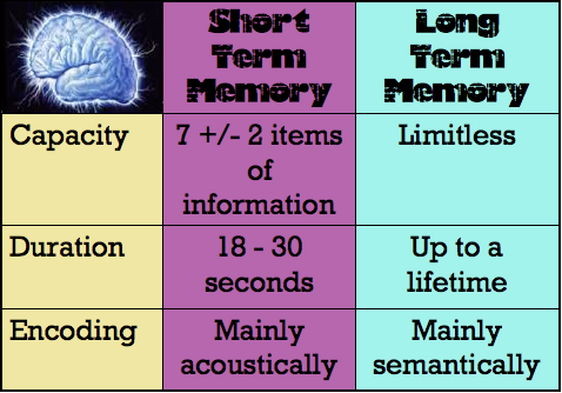
We covered duration in LTM; we discussed children's TV programmes and the difference between recall and recognition. We looked at Bahrick's study, which found good evidence for the duration of long-term memories. Recognition (cue provided) was better than recall. Here is the duration in LTM powerpoint.

We then looked at capacity in STM. We measure our average digit span to be around 7.2 items. Miller defined STM capacity as being 7 plus or minus 2, and looked at the idea of chunking. We discussed postcodes and telephone numbers as real life applications of chunking. Remember that chunking isn't wholly foolproof; the size of the chunk does matter (Simon, 1974). Here is the capacity powerpoint.

Finally we discussed encoding in STM and LTM. We replicated the Baddeley (1966) study. For STM, participants did worse in the acoustic similarity category. Baddeley concluded that this meant that the brain codes acoustically in STM. This is a crucial point! If you don't follow, please ask next lesson. For LTM, people performed worse in the semantic similarity category, showing that this is how the brain codes in long-term memory. Here is the encoding powerpoint.


It's vital that you go over the powerpoints and all the information covered today. This will be easier when you have textbooks but is still possible now. 

Wednesday, 10 September 2014

The man who keeps falling in love with his wife


Today we introduced our first unit 1 module - memory. We discussed the case of  Clive Wearing and the implications of this for how important memory is. Here is an interesting summary of Clive's memory history. Interestingly, his musical memory appears intact and this article explores why this might be.

Here is today's powerpoint containing the notes on Peterson & Peterson (1965).

Mrs Watson